Author Archive

Wellington Mayoral candidate Celia Wade-Brown on dressing sustainably

Tuesday, August 24th, 2010

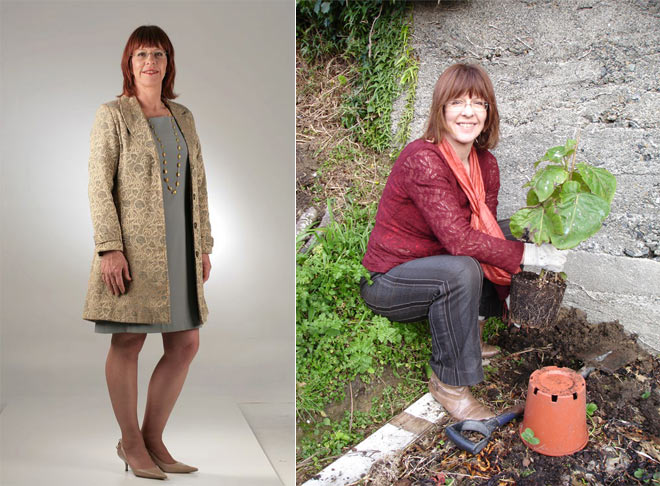
We were stoked to get the chance to talk to Celia about dressing sustainably while still looking snappy as a Councillor. Especially in the lead-up to the Wellington Mayoral elections, it’s great to see how an environmental conscience doesn’t stop at the fashion gate (so to speak), and, at any time, it’s refreshing to see politicians do what they preach. Celia, you got my vote!

What is your motivation behind making sustainable fashion decisions?
Getting ready for the Mayoral campaign has been a learning curve I’ve relished. As well as explaining new policy and good achievements like safer cycling, light rail, computer access for refugees, cleaner city harbour, ultrafast broadband, Fairtrade Capital and community gardens, now I have to dress to show I can lead the city, without sacrificing my values – or over-spending. Fortunately, choosing clothes can be fun and sustainable!

How do you go about finding the right stuff?
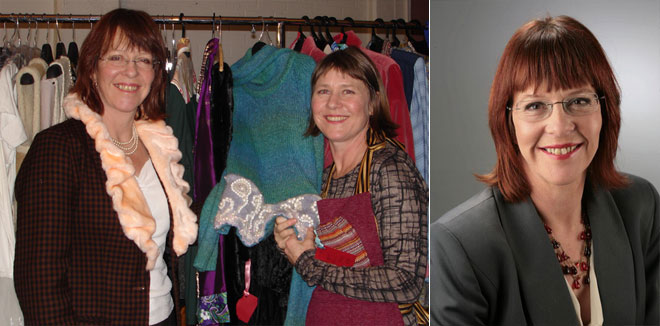
After a few colour tips from Samantha Hannah, I met some very sympathetic Wellington fashion designers and added to my op shop collections. A quick explore when I’m passing the Salvation Army in Rintoul St, Taranaki St or Tawa is usually worthwhile, even for basics like jeans. In more up-market spots in Cuba Street like the Recycle Boutique or, for something really special, Ziggurat, I often find a beautiful bargain. Jewelry is either a few well-loved pieces from my mother, made by myself or sourced from Trade Aid for a splash of colour.

What did you score in your latest quest?
I wanted smart pieces in cream so I enjoyed choosing a linen jacket from Untouched World, a silk shirt from Starfish and an end-of-line bargain from Voon. I’m sure these choices will last me for many years. Janet Dunn has set up ReDunn Fashions to up-cycle pre-loved clothing and I bought this amusing jacket at her first soirée. Natural fabrics, recycled gear and new ethical items make a happy combination -lovely clothes and good businesses.

Salvation Army jacket / Andrea-Moore top

Janet Dunn jacket / 'Annual Preloved Fashion Sale'-jacket and Starfish blouse

-Thomas

A note to our readers

Sunday, August 22nd, 2010

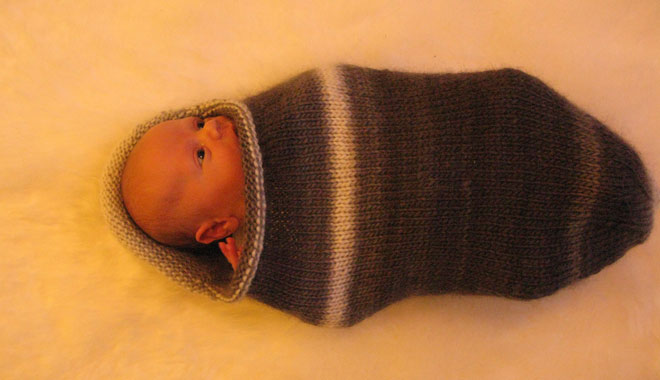
It’s time to give you guys out there a little (very little) update. As some of you may know, we’ve had a recent addition to our team a few weeks ago now, and his name his Otis Forrest. He’s still pretty small, so can’t do any editing jobs yet, so bear with us over the next while if our blog is a bit slow. He’s provided us with great joy already and we’re looking forward to all the future time with him.

Otis

-Thomas & Hannah

Be a conscious consumer

Monday, June 7th, 2010

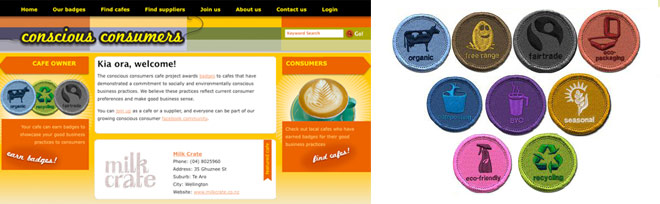
If you’re out and about and just don’t know what cafe is really cutting the carbon, or grinding those fairly traded beans, or steaming organic milk, here is a great idea, freshly launched, to help you make the right choice: consciousconsumers.org.nz, a project developed by the Wellington based 42collective.

The site is reviving the idea of using badges to reward certain behaviour, and this collection of badges makes it easy for you, the consumer, to pick your favourite cafe with a conscience. You can also follow the Conscious Consumers Wellington group on facebook!

-Thomas

Solar convection heater

Friday, June 4th, 2010

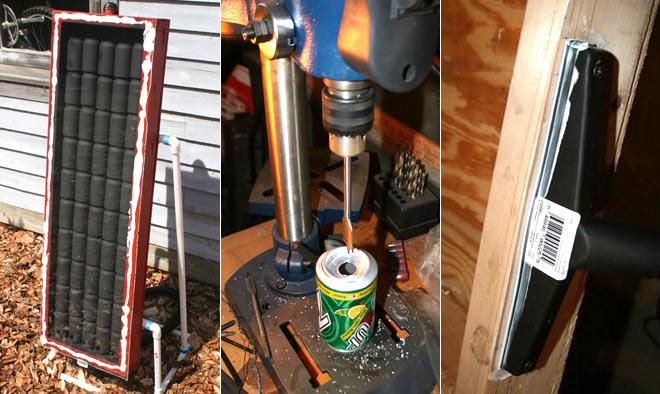
Winter is almost upon us and, knowing how cold it can get in our mildly insulated flat, we welcomed this making idea Anthea forwarded to us: a solar convection heater made out of pop/beer cans. Apart from wondering where to get that many empty cans from, I do appreciate the idea of giving them a second life.

If my workshop wasn’t that small and east facing I’d consider installing something there. The more I look at the idea though, the likelier it becomes I’ll work on a properly sized version for our flat – maybe 100 cans instead of 50, as in the example. The instructions for this project you can find on a blog all about cars, strangely enough; car enthusiasts do spend many hours in cold garages, after all.

I’m also quite intrigued by the commercially produced solar heater now (oh, them inventive Canadians!). A testament to the efficiency of the product is that it was actually developed in the cold North.

Now, don’t start sending me your sticky, empty pop cans (in fact, avoiding them in the first place would be much better), but I may have to arrange for some fun dumpster diving times.

-Thomas

Not mine!

Thursday, May 20th, 2010

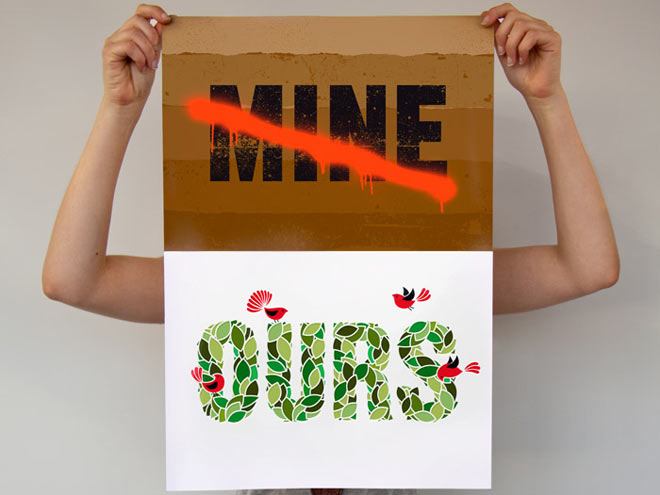
Ours, not mine!

A very clever visualization by Natasha Vermeulen of the core values of the anti-mining protests – free to download and share at endemicworld.com.

– Thomas

Frankenstein’s drawers

Wednesday, March 24th, 2010

I have often thought about the aesthetic of reused and recycled rather than store-bought materials. What I’ve noticed is that things made from old stuff always seems to come out on top when it comes to character and uniqueness. This little chest of drawers is a case in point.
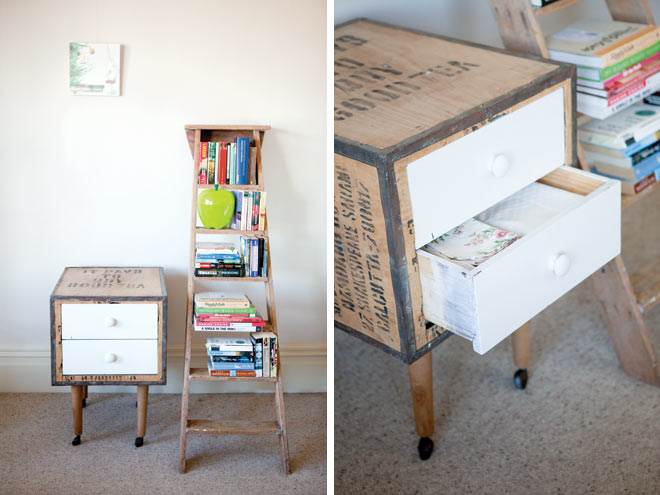
Our Frankenstein's Drawers made out of tea-boxes

The starting point for this project was a few wooden tea boxes we found under our house, and while they’re great boxes, they are a bit too high for a bedside table, not sturdy enough for a TV stand, and too chunky for desk legs. In all their prettiness, we always felt that they had to serve a higher purpose. We started thinking laterally about the box. Often you have an idea or a concept to begin with, but it this case it was the material that was the starting point for the creative process. Lying on its side with the box’s top opening pointing forward, the idea for a chest of drawers evolved.

Because of the project depending so much on the material you can get hold of, this is not a strict step-by-step project to copy, but rather ideas and tips for the design process behind a project similar to this.

SOURCING THE MATERIAL

The ‘box’: This is where you have absolute creative freedom – a variety of wooden boxes work; if you don’t have awesome tea boxes like us, you could use old gutted chests, wooden packaging or crates, or even sturdy suitcases (wow, that’ll be my next project!).
Drawers: Being on the lookout for drawers that might fit (so I didn’t have to build new ones), I was lucky enough to find a cheap desk at the op shop with drawers which fell into my range of “could fit” dimensions.

Legs: We had four legs from an old bed-base lying around that we wanted to put to use, so the decision about composition was made for us. With these slender, long legs, I envisaged something like a love child of a Cheetah and “A Grand Day Out with Wallace and Gromit”’s slightly deranged vending machine “the Cooker”. Of course, you could use any type of legs you want, even pimp it out with swivel top casters, which would make assembly quite easy but can be quite pricy.
Interior material: I used scrap material from my workshop for the interior of the box, otherwise I would have used pieces from the second hand desk I bought for this project.

FIT THE DRAWERS

1. I measured the drawers and trimmed the opening in the box appropriately, so the drawers would sit snugly without gaps.
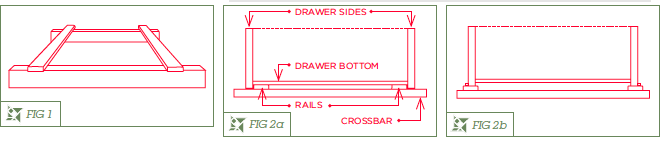
Illustrating the construction Figs 1, 2a and 2b

BOX INTERIOR

2. The construction I built inside the box had to be sturdy and smooth enough for the drawers to sit and run on easily.
Basically, you need two rails running front to back for each drawer, and two sturdy crossbars per drawer that the rails sit on FIG 1. To figure out how to construct this, you need to have a closer look at your drawers (yes, indeed). Usually, drawers’ bases
are set slightly up from the bottom, so that the drawer actually runs on its sides, not the bottom. In this case though, I figured
the easiest thing to do was to have the drawer’s base run on two rails, sitting just inside the sides FIG 2a.

Make sure that the rails are a bit taller than the distance between the drawer’s base and the bottom of its sides,
otherwise the drawer will catch on the crossbars when closing.

If the bottom of your drawers are not sturdy or straight enough, your drawers’ sides have to run on the rails. If this is
the case, attach a strip to the rails on either side of the drawer to keep it in place as it slides along FIG 2b.

3. The rail method you choose will inform the height the crossbars are attached at. If you have the drawers sitting on
top of the rails, you need to lower the crossbars appropriately, by the height of the rails.

4. To attach the crossbars, hold them in place on the inside and at the same time drill from the outside through the box’s wall
into the end grain of the crossbars, then screw in place FIG 3.

5. Attach the rails onto the crossbars. Make sure they fit the drawers’ widths, and stop the drawers from sliding in too far. TIP: All elements need to come together correctly to have the drawers sit perfectly in the opening and to prevent the drawers from jarring, so make little sketches first, then measure and then sketch some more – it’s all part of the fun design process.
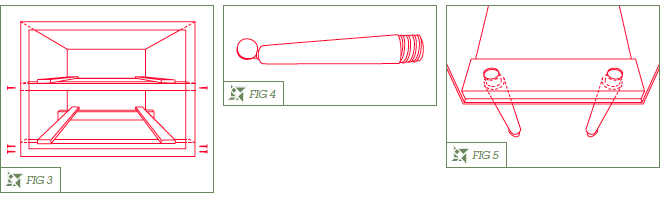
Illustrating the construction Figs 3, 4 and 5

GIVING IT LEGS

6. The legs I used have a thread at the top FIG 4, which I figured would be quite sturdy to attach them with. As counterparts for the threads, I attached two lengths of wood to the inside bottom of the box – one counterpart to hold the front legs and the other for the back ones. With a hole saw, I cut two holes from the outside through the box bottom into the lengths of wood tomatch the intended position of the legs. By cutting the holes slightly smaller in diameter than the thread, I then just had to twist the legs through the bottom of the box into the holes. They cut a slight thread into the counterparts and by doing so automatically tightened up nicely. No further screws or glue needed FIG 5!

FINISHING TOUCHES

7. The tea box has nice print on it – “It pays to buy good tea”, so I didn’t give it another finish. The drawers were white, so that worked as a nice contrast to the overall wood look. A bit of candlewax on the rails and drawer bottoms makes a hell of a difference in making the drawers run smoothly. “Alive! It’s alive!”
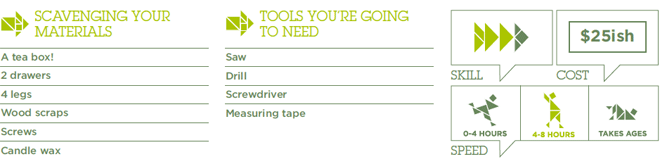
Materials and tools, skills, cost and speed

Folding stuff

Monday, March 22nd, 2010

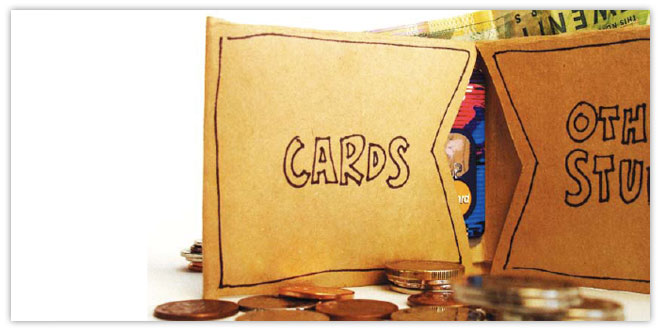
This wallet is super easy to make. You’ll need some paper and cellotape. Yep, that’s it. Grab a vivid and twink if you want to customise it, or use the latest pages from the ace review of the new “Die Die Die” album, if that’s more your thing. Heavier card is slightly more durable and using the front of a manilla folder makes the wallet feel like a freakin’ hummer.
Paper wallet

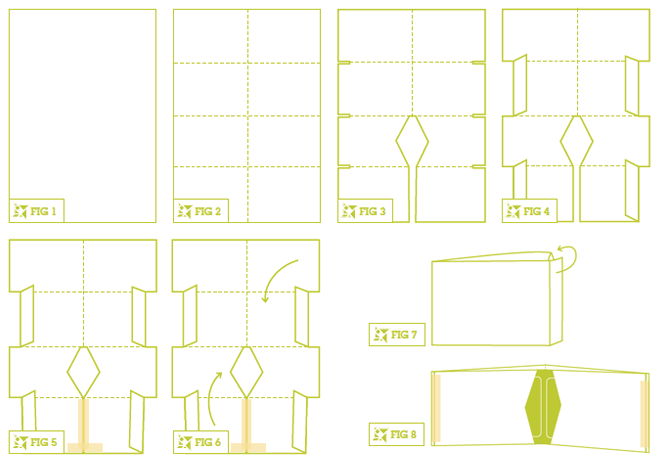
  1. Start with a piece of A4 or similar – slightly bigger is best (about the size of Real Groove Magazine pages is excellent). FIG 1
  2. Crease by folding in half and half again, and then again so your page is divided into eight. FIG 2
  3. Cut as shown. You’ll need slits in the side and the cut out diamond becomes the card holder part. FIG 3
  4. Make some flaps out of the bottom and top sections. These will eventually fold into the wallet and seal it up so your cards don’t drop out the side. FIG 4
  5. Tape the bottom bits back together so both sides are flush. It will seem kind of wonky now but it all will be revealed soon. FIG 5
  6. Fold the top and the bottom quarters in, FIG 6 then fold in half and you should have something like FIG 7 with the flaps poking out the side.
  7. Tuck the flaps into the hole you’ve just created and this will effectively lock the wallet together. You can use tape if you want to be extra sure nothing’s going to fall out.
  8. You should have something that looks a bit like FIG 8. Your cash goes in the back and your cards go in the 2 easy access pockets at front. Sorted.

Illustrations for 'Folding stuff'

Our final subscription winner

Monday, March 22nd, 2010

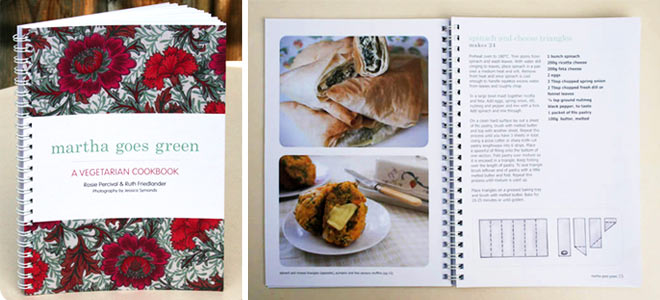
We just determined our final subscription winner in a ceremonial draw. Jamin Vollebregt, from Island Bay in Wellington, you won the book “Martha goes Green: A Vegetarian Cookbook”. Yay!

Martha goes green: a vegetarian cookbook

My mamachari

Sunday, March 21st, 2010

I recently joined the movement for a shift in the means of transport by acquiring a brand-new, second-hand mamachari bicycle. The reason for getting the bike though was to have a classier, more leisurely way of getting around every day. When I finally put it to use, cycling back home from the city, a slight feeling of warm melancholy overcame me, being reminded of cruising through my home city of Hamburg.

My mamachari bike on our street

Responsible for my new-found joy of cycling in New Zealand are Sarah and Jason, our downstairs neighbours, who imported the mamachari bikes from Japan, to imprint Wellington streets with new, bike-friendly, city-life looks. A brand new website with all details will be up at mamachari.co.nz soon.

My mamachari bike in our kitchen

Thomas

Thank you, and goodnight

Tuesday, March 2nd, 2010

Dear all readers,

It’s two years ago this month that we published the first issue of World Sweet World, and the speed at which our little mag for makers and doers was embraced by the creative, crafty community of New Zealand (and beyond!) just blew our minds.

We wanted to make World Sweet World an inclusive, sharing sort of publication, and that baton has been taken up and run with by so many of you. Since the third or fourth issue, we’ve had a constant flow of new content pour in, supplied almost entirely by people we’ve never met. It’s been incredibly exciting to open our inbox each morning to read messages from people wanting to share their ideas with our readers.

Big changes are ahead here at World Sweet World HQ, and we’ve been having a big think about the future of our mag over the last couple of months. We’re excited to announce: we’re having a baby in July! So this really made us re-evaluate what we’ll be able to manage over the next years. While we utterly enjoy putting World Sweet World together, the magazine has been a labour of love (and not money) for the last couple of years. We don’t see ourselves being able to put nearly the amount of time and energy into it once we have another little project to pour our time into. It’s been an absolute pleasure, lots of fun, and a great learning curve, but we have decided to put the mag to rest, with this being our last issue.

We’re keeping the blog ticking over, so if you have projects or articles you’re still busting to share, do get in touch. We’ll also be adding projects and articles from past issues, plus, due to popular demand, we’re working on enabling you to buy digital copies of sold out back issues. One of our favourite parts of putting each new issue together has been commissioning new artwork by such incredibly talented illustrators. We’ve drooled over Devon Smith’s work in Swonderful here in Welly, and were a couple of excited children when she got in touch two months ago to say she’d like to contribute. We’re thrilled with the work she’s done for the cover, and also the adorable illustrations by Sarah McNeil for the Crafty Business article. Hopefully you’ll enjoy them too, along with all the other content we’ve rounded up in this issue.

We’ve been truly proud of each new issue we put out, and we hope we have been able to inspire the makery scene in New Zealand and to make a positive difference to the world we live in. Thanks once again for the overwhelming support you’ve shown us over the course of this adventure.

Thank you, and goodnight – Hannah & Thomas