Fabric-a-brac this Saturday!

June 17th, 2010

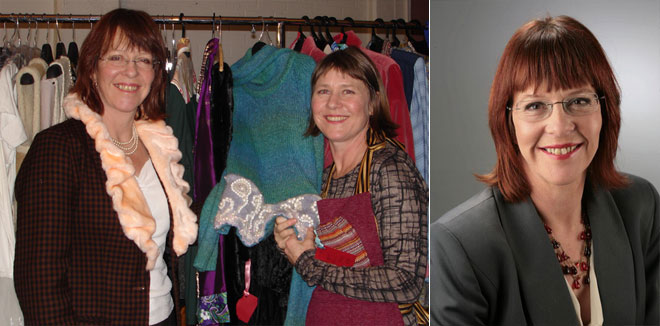
Once again I’ve left it a little late to blog about this, but if you’re in welly this weekend I’d HIGHLY recommend popping by St Anne’s Church hall at the end of Emmett St in Newtown for Fabric-a-brac, to stock up on your sewing stash, and help someone else clear out theirs.

Bring along your sewing scissors if you need to get them sharpened, and they’ll also be able to answer your sewing machine maintenance questions and have sewing machine needles at great prices.

There will be the usual selection of vintage and modern fabrics, with highlights being special European designer fabrics and trims, some oh-so-cute Japanese fabric, high-quality upholstery fabric and a huge selection of buttons.

I’m especially excited about getting some goodies from Stitchbird and that lady with the amazing vintage buttons… See you there!

Craft 2.0 this Saturday!

June 9th, 2010

We’re excited to announce that we’ve managed to track down a limited number of back issues which have been sold out for a while now, so for our last hoorah at our favorite fair this weekend, we’ll have some COMPLETE SETS of World Sweet World for sale.

As well as the sets, we’ll also be selling single copies of issues 3-9, so if I were you, I’d head out to the Dowse this Saturday (June 12) from 10am – 3pm to make sure you get those issues you need to complete your collection.

After the fair, if there are any left, we’ll pop them up on the website for sale, but as we’ve had lots of people contacting us, wanting to get hold of them, I can’t guarantee there will be any left by the end of the day.

Looking forward to our last fair (behind a stall anyway) for a while. There are so many fantastic stallholders on the list that I imagine we’ll be doing quite a bit of buying this time, as well. Check out the Craft2.0 blog for more info on which crafters will be there selling their wares, and hopefully we’ll see you in the Hutt in a couple of days!

Be a conscious consumer

June 7th, 2010

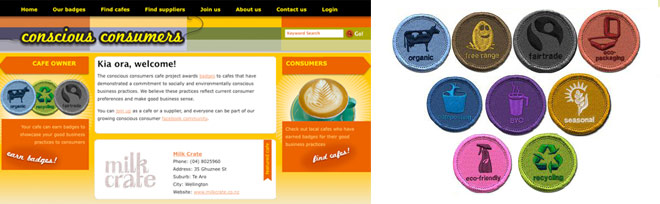
If you’re out and about and just don’t know what cafe is really cutting the carbon, or grinding those fairly traded beans, or steaming organic milk, here is a great idea, freshly launched, to help you make the right choice: consciousconsumers.org.nz, a project developed by the Wellington based 42collective.

The site is reviving the idea of using badges to reward certain behaviour, and this collection of badges makes it easy for you, the consumer, to pick your favourite cafe with a conscience. You can also follow the Conscious Consumers Wellington group on facebook!

-Thomas

Solar convection heater

June 4th, 2010

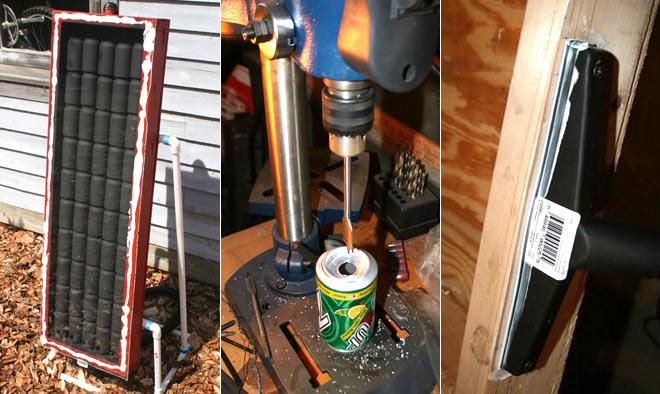
Winter is almost upon us and, knowing how cold it can get in our mildly insulated flat, we welcomed this making idea Anthea forwarded to us: a solar convection heater made out of pop/beer cans. Apart from wondering where to get that many empty cans from, I do appreciate the idea of giving them a second life.

If my workshop wasn’t that small and east facing I’d consider installing something there. The more I look at the idea though, the likelier it becomes I’ll work on a properly sized version for our flat – maybe 100 cans instead of 50, as in the example. The instructions for this project you can find on a blog all about cars, strangely enough; car enthusiasts do spend many hours in cold garages, after all.

I’m also quite intrigued by the commercially produced solar heater now (oh, them inventive Canadians!). A testament to the efficiency of the product is that it was actually developed in the cold North.

Now, don’t start sending me your sticky, empty pop cans (in fact, avoiding them in the first place would be much better), but I may have to arrange for some fun dumpster diving times.

-Thomas

Not mine!

May 20th, 2010

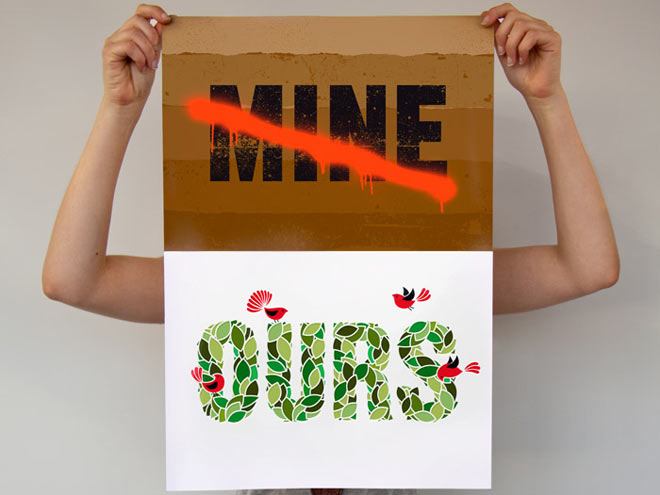
Ours, not mine!

A very clever visualization by Natasha Vermeulen of the core values of the anti-mining protests – free to download and share at endemicworld.com.

- Thomas

Calling all stitchers!

April 26th, 2010

Freakin amazing embroidery by Jenny Hart of Sublime Stitching

I’ve just received a very exciting email from the incredible Leanne Prain who wrote Yarn Bombing: The Art of Crochet and Knit Graffiti. After being interviewed for The knitty-gritty of craftivism in issue 8 of WSW, Leanne has gotten underway with a new book project . She’s really keen to have submissions from all over the world for her new title, Hoopla, The Art of Unexpected Embroidery, and asked me to pass this on to all keen stitchers:

Do you design unusual or unexpected pieces of needlepoint? If so, you should design a pattern for Hoopla, The Art of Unexpected Embroidery, to be published by Arsenal Pulp Press in autumn 2011.

Hoopla: The Art of Unexpected Embroidery rebels against the traditional notions of quaint embroidery with motifs of flowers and songbirds. The book will feature unusual stitch work on a variety of surfaces and textures. With off-beat patterns including subway maps, feminist Girl Guide badges, and metal band letterforms; Hoopla will demonstrate that modern embroidery artists are as sharp as the needles that they work with. If you describe your stitch-work as arresting, subversive, quirky, or conceptual, Hoopla should feature your design work.

Yeehaa! Check out the unexpected embroidery site for more info on how to get involved.

Curtain call: part two

April 26th, 2010

Homemade thermal insulated curtains

In last autumn’s issue of World Sweet World mag we published the great project by Christine Reitze (check it out here) showing you how to make snuggly winter curtains out of blankets. We have the beauties from that project hanging in our bedroom already, but with winter looming again I figured I needed to kit out the rest of the house. The only problem is that, living in a villa with super-tall windows, I’ve been struggling to find blankets that will be long or wide enough to do the trick.

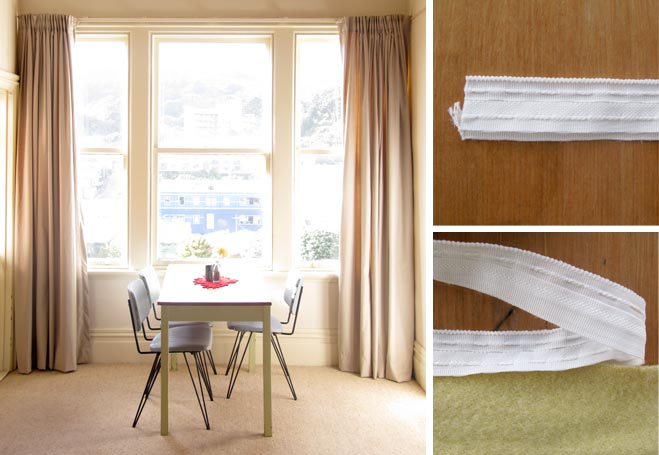
On a recent trip to the fabric shop I stumbled across the perfect solution: Lining tape. Now this may sound kind of obvious, but using blankets as lining instead of the main act means that it doesn’t matter if they don’t reach the ground, and they don’t have to be as wide, because the lining doesn’t need to be gathered. Bingo!

Because our windows are so big, I opted for a cheap ($5m), medium-weight fabric, knowing that with the blankets they’d still feel nice and heavy. I made some simple curtains (check out the previous post if you don’t know how to do that), sewed lining tape to the top of a blanket, and then hung the blanket to the back of my curtains with hooks. I now have full-length, totally insulated curtains that look heavy and drape well, and they only cost me around $60, including the blankets, tape and hooks.

I’m stoked with how much difference they make to the room, and our landlord is getting a grant to install insulation and a heatpump through the EECA energywise scheme , but we’re still keen to do further winter-proofing before we have a tiny child in the house.

Any ideas? What are you doing to keep your diggs toasty this winter?

Curtain call: part one

April 23rd, 2010

Homemade blanket curtains

This project by Christine Reitze was published last autumn in issue 5 of World Sweet World. Stay tuned for more curtain-related goodies next week – I’ve been sewing up a storm in preparation for the chilly months ahead. ~ Hannah

It’s always good to be prepared, so here’s an autumn project that will get you ready for winter. In the grand scheme of things, winters in New Zealand aren’t really that cold, but because of practically nonexistent insulation in many of our houses (especially flats), we tend to feel it more than chillier countries.

If you’re flatting in a cold house, chances are your landlord isn’t going to fork out to get the entire place re-insulated (although it’s worth speaking with them about the EECA energywise funding scheme), but there are things as tenants we can do to keep a bit warmer as winter approaches.

These warm woolly winter curtains are sewn with old blankets you can find easily in op-shops for cheap, or if you’re brave enough, you could pinch them from your granny or your dog. For even more warmth you can add thermal lining (you can use your old curtains for this), which is then hooked onto the main wool curtain.

  1. Measure the length of your curtain track and double it, adding an extra 12cm. This is how much of wide curtain tape you’ll need.
  2. If you decide to have the extra thermal insulation you will need to buy the same length of narrow curtain tape for it. Make sure that the wide tape of your woolly curtain can be used to hook the lining onto (they can tell you this in the shop).
  3. Decide how long you want your curtain to be, and add 5cm. I reckon down to the floor looks best, plus it provides far more insulation that way. If you want to hem your curtain you will need to add extra length, but wool blankets are usually nicely hemmed anyway.
  4. Make each of your two curtains the width of the curtain track. Depending on the size of your wool blankets, you might need to cut off or sew more blanket material on to get the right dimension for your window. You can get creative here and sew stripes, have a different coloured border or make a woollen patchwork. If you sew two different blankets together, make sure you pin them first (even if pinning isn’t usually your style). Different weights of blanket will stretch differently, and you’ll end up with one piece that looks flabby like the knees in a cheap pair of trackies. Not cool. How to sew the tape on
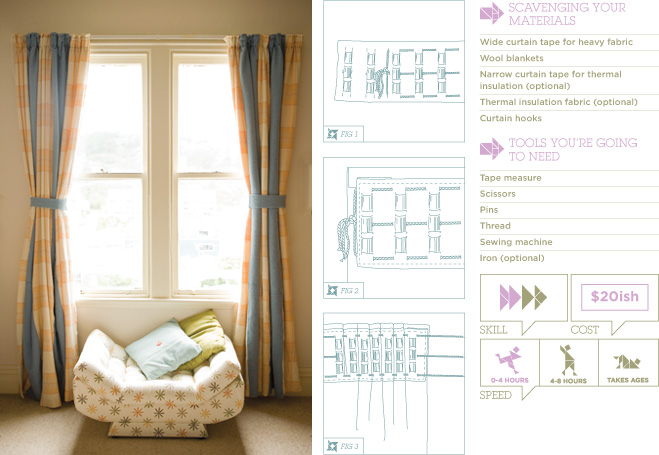
  5. Cut the curtain tape in half. Before you start sewing, unthread the three cords 3cm from one end of the tape. Tie the cords together, then smooth out the tape  FIG 1.
  6. Place the tape right side up on the panel, 2cm below the edge of the curtain. Fold in the excess tape 3cm from each end and pin the tape in place.
    Sew the top edge of the tape about ½ a cm from its edge onto the curtain and repeat the process with the bottom edge  FIG 2. Be careful not to sew over the string!
  7. Pull all strings at the unknotted end at the same time, gathering your curtain to the desired width  FIG 3. It should end up half the curtain track plus about 40cm. Knot the three strings together and cut the excess off.
  8. Insert hooks into the middle of every second or third loop of the tape.
  9. Repeat the same process with your second curtain panel, hang them up and feel the instant warmth! For extra thermal insulation
  10. To add extra warmth to your woolly drapes, you can make an ungathered thermal backing. For the width, measure the gathered width of your wool curtain and add an extra 20cm. The length will be the same as the wool curtains, minus 20cm.
  11. Fold the side edge of your lining over 5cm and iron, then fold it over another 5cm, iron and sew in place. Repeat the process with the other side.
    Pin the lining tape on, folding 3cm under at the edges, and sew in place, as you did in step 7.
  12. Insert hooks into every fourth loop and hook the lining onto the bottom row of loops on the curtain tape.

If you’ve taken old curtains down from your windows, these will work just as well for lining. All you have to do is move the hooks from the middle of the tape to the top, hook them onto your curtain, and you’re sorted!

Frankenstein’s drawers

March 24th, 2010

I have often thought about the aesthetic of reused and recycled rather than store-bought materials. What I’ve noticed is that things made from old stuff always seems to come out on top when it comes to character and uniqueness. This little chest of drawers is a case in point.

Our Frankenstein's Drawers made out of tea-boxes

The starting point for this project was a few wooden tea boxes we found under our house, and while they’re great boxes, they are a bit too high for a bedside table, not sturdy enough for a TV stand, and too chunky for desk legs. In all their prettiness, we always felt that they had to serve a higher purpose. We started thinking laterally about the box. Often you have an idea or a concept to begin with, but it this case it was the material that was the starting point for the creative process. Lying on its side with the box’s top opening pointing forward, the idea for a chest of drawers evolved.

Because of the project depending so much on the material you can get hold of, this is not a strict step-by-step project to copy, but rather ideas and tips for the design process behind a project similar to this.

SOURCING THE MATERIAL

The ‘box’: This is where you have absolute creative freedom – a variety of wooden boxes work; if you don’t have awesome tea boxes like us, you could use old gutted chests, wooden packaging or crates, or even sturdy suitcases (wow, that’ll be my next project!).
Drawers: Being on the lookout for drawers that might fit (so I didn’t have to build new ones), I was lucky enough to find a cheap desk at the op shop with drawers which fell into my range of “could fit” dimensions.

Legs: We had four legs from an old bed-base lying around that we wanted to put to use, so the decision about composition was made for us. With these slender, long legs, I envisaged something like a love child of a Cheetah and “A Grand Day Out with Wallace and Gromit”’s slightly deranged vending machine “the Cooker”. Of course, you could use any type of legs you want, even pimp it out with swivel top casters, which would make assembly quite easy but can be quite pricy.
Interior material: I used scrap material from my workshop for the interior of the box, otherwise I would have used pieces from the second hand desk I bought for this project.

FIT THE DRAWERS

1. I measured the drawers and trimmed the opening in the box appropriately, so the drawers would sit snugly without gaps.

Illustrating the construction Figs 1, 2a and 2b

BOX INTERIOR

2. The construction I built inside the box had to be sturdy and smooth enough for the drawers to sit and run on easily.
Basically, you need two rails running front to back for each drawer, and two sturdy crossbars per drawer that the rails sit on FIG 1. To figure out how to construct this, you need to have a closer look at your drawers (yes, indeed). Usually, drawers’ bases
are set slightly up from the bottom, so that the drawer actually runs on its sides, not the bottom. In this case though, I figured
the easiest thing to do was to have the drawer’s base run on two rails, sitting just inside the sides FIG 2a.

Make sure that the rails are a bit taller than the distance between the drawer’s base and the bottom of its sides,
otherwise the drawer will catch on the crossbars when closing.

If the bottom of your drawers are not sturdy or straight enough, your drawers’ sides have to run on the rails. If this is
the case, attach a strip to the rails on either side of the drawer to keep it in place as it slides along FIG 2b.

3. The rail method you choose will inform the height the crossbars are attached at. If you have the drawers sitting on
top of the rails, you need to lower the crossbars appropriately, by the height of the rails.

4. To attach the crossbars, hold them in place on the inside and at the same time drill from the outside through the box’s wall
into the end grain of the crossbars, then screw in place FIG 3.

5. Attach the rails onto the crossbars. Make sure they fit the drawers’ widths, and stop the drawers from sliding in too far. TIP: All elements need to come together correctly to have the drawers sit perfectly in the opening and to prevent the drawers from jarring, so make little sketches first, then measure and then sketch some more – it’s all part of the fun design process.

Illustrating the construction Figs 3, 4 and 5

GIVING IT LEGS

6. The legs I used have a thread at the top FIG 4, which I figured would be quite sturdy to attach them with. As counterparts for the threads, I attached two lengths of wood to the inside bottom of the box – one counterpart to hold the front legs and the other for the back ones. With a hole saw, I cut two holes from the outside through the box bottom into the lengths of wood tomatch the intended position of the legs. By cutting the holes slightly smaller in diameter than the thread, I then just had to twist the legs through the bottom of the box into the holes. They cut a slight thread into the counterparts and by doing so automatically tightened up nicely. No further screws or glue needed FIG 5!

FINISHING TOUCHES

7. The tea box has nice print on it – “It pays to buy good tea”, so I didn’t give it another finish. The drawers were white, so that worked as a nice contrast to the overall wood look. A bit of candlewax on the rails and drawer bottoms makes a hell of a difference in making the drawers run smoothly. “Alive! It’s alive!”

Materials and tools, skills, cost and speed

Folding stuff

March 22nd, 2010

This wallet is super easy to make. You’ll need some paper and cellotape. Yep, that’s it. Grab a vivid and twink if you want to customise it, or use the latest pages from the ace review of the new “Die Die Die” album, if that’s more your thing. Heavier card is slightly more durable and using the front of a manilla folder makes the wallet feel like a freakin’ hummer.
Paper wallet

  1. Start with a piece of A4 or similar – slightly bigger is best (about the size of Real Groove Magazine pages is excellent). FIG 1
  2. Crease by folding in half and half again, and then again so your page is divided into eight. FIG 2
  3. Cut as shown. You’ll need slits in the side and the cut out diamond becomes the card holder part. FIG 3
  4. Make some flaps out of the bottom and top sections. These will eventually fold into the wallet and seal it up so your cards don’t drop out the side. FIG 4
  5. Tape the bottom bits back together so both sides are flush. It will seem kind of wonky now but it all will be revealed soon. FIG 5
  6. Fold the top and the bottom quarters in, FIG 6 then fold in half and you should have something like FIG 7 with the flaps poking out the side.
  7. Tuck the flaps into the hole you’ve just created and this will effectively lock the wallet together. You can use tape if you want to be extra sure nothing’s going to fall out.
  8. You should have something that looks a bit like FIG 8. Your cash goes in the back and your cards go in the 2 easy access pockets at front. Sorted.

Illustrations for 'Folding stuff'